

What Do We Know?
Chemists have developed a powerful molecular-level model to explain the bulk properties of gases. The model is generally referred to as the kinetic molecular theory. Kinetic molecular theory is based upon the assumption that all matter is composed of particles that have energy. As a result, the particles are in constant motion.
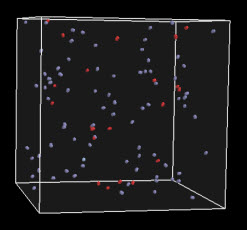
The kinetic molecular theory model of gases states that:
- Gases are composed of tiny particles that are very far apart from each other at reasonably low pressures and high temperatures. As a result, intermolecular forces between the particles are negligible.
- Gas particles move continuously and randomly. The particles move in straight lines, but they constantly collide with each other and with the walls of the container. Collisions take place without reducing the total energy of the system.
- The temperature of the gas is proportional to the average kinetic energy of the particles in a gas. At the same temperature, all gas samples will have the same average kinetic energy, regardless of the size or mass of the gas particles in the sample.